Entradas

Mostrando las entradas etiquetadas como GEOGRAPHY AND HISTORY

Cultural Heritage

Imagen
  Cultural heritage   is the legacy of physical artifacts and intangible attributes of a group or society   that is inherited from past generations. Cultural heritage includes tangible culture  (such as buildings, monuments, landscapes, books, works of art, and artifacts), intangible culture (such as folklore, traditions, language, and knowledge), and natural heritage (including culturally significant landscapes, and biodiversity). The deliberate act of keeping cultural heritage from the present for the future is known as  conservation. Cultural heritage and society   Cultural heritage is the fabric of our lives and societies. It surrounds us in the buildings of our towns and cities; our landscapes, natural sites, monuments and archaeological sites.It is not only made up of literature, art and objects but also by the crafts we learn, the stories we tell, the food we eat, the songs we sing and the films we watch. Cultural heritage brings comm...
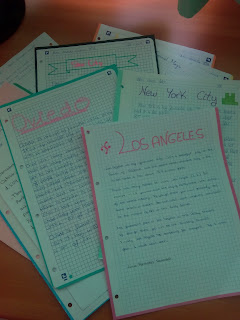
Projects: A fact sheet about a city

Imagen
Our students have been working on a project about different cities around the world . They have done it individually or in pairs and they have presented their power points to the rest of the class. We have recorded some of them and the result has been very positive.    Here is a list of sites where we have practiced own knowledge on geography:  There are some map quiz games which are really fun and can also be a great way to learn more about countries and cities: https://lizardpoint.com/geography/europe-caps-quiz.php https://online.seterra.com/en/vgp/3073 Here you can see some of the projects the students have presented orally: Some of them have travelled to European countries : PARIS by Olaya and Mónica: Others have crossed the Ocean and have visited the United States :  NEW YORK   by Noemí: Finally some other students have chosen interesting cities in ...

Ancient World

Imagen
Our students are working on their projects:  - Stonehenge - The mummification - Tutankhamun´s tomb - The Seven Wonders of the Ancient World - The Olympic games - The Hispanic emperors Resources: THE MUMMIFICATION:        n   The Egyptians believed that when they died, they would make a journey to another world where they would live a new life. n   Egyptians paid great amounts of money to have their bodies properly preserved, ready for the after life. Egyptians who were poor were buried in the sand while the rich ones were buried in a tomb. n   Rich Egyptians were preserved properly. This process was called mummification. n   Mummification took about 72 days. n   The body was washed with water from the Nile and taken to a place called “per nefer” where the mummies were made. n   The chief embalmer made a cut on the left side of the abdomen and removed the internal organs. He placed them in canopic jar...

Ancient calendars

Imagen
The ancient Egyptian calendar The ancient Egyptians were the first civilization to create a calendar which organised the year into 365 days . This calendar is believed to date back to the 3 ͬ ͩ millennium BC. The year consisted of 12 months of 30 days each one plus five holy days. The months were divided into three weeks of ten days each. The Egyptian year was divided into three seasons of four months. These seasons were: The season of Akhet (Inundation) The season of Peret (Growth-Winter) The season of Shemu (Harvest-Summer)   The Egytian calendar was known to be imperfect as it was almost a quarter of a day shorter than the true solar year. Image representing the sky and the constellations The ancient Greek calendar The Greek calendar includes a variety of dating systems used by the several city-states in the time of classical Greece . There was no uniform calendar imposed upon all of the Hellenic territory. Each polis had i...